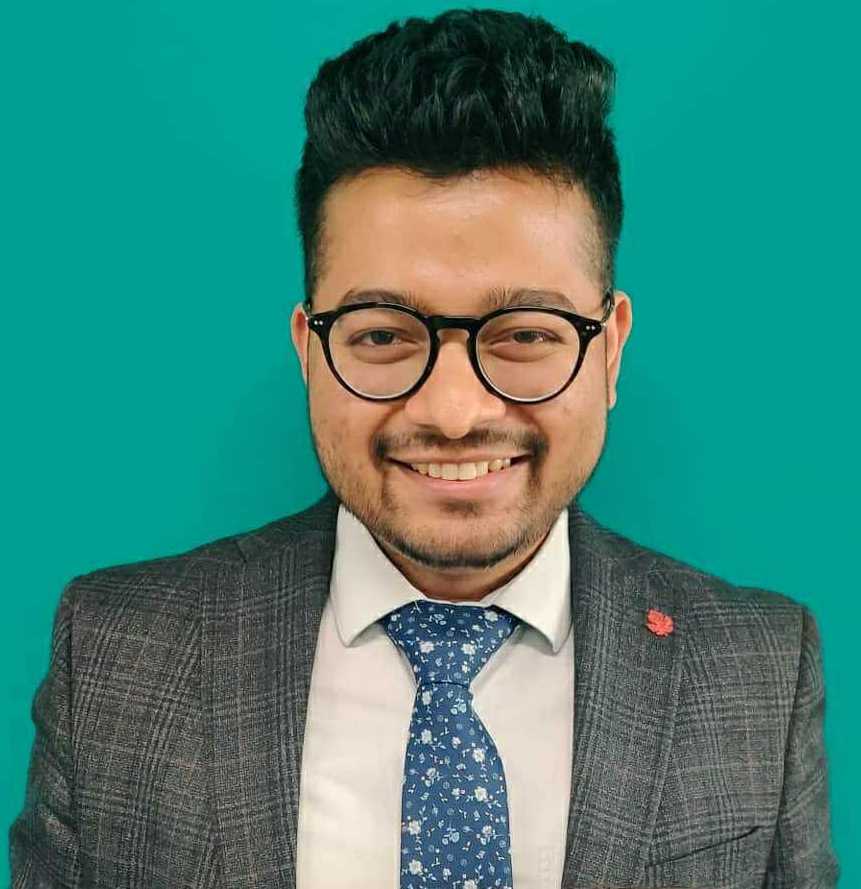
Jyotikrishna Dass is an assistant professor in the Department of Electrical and Computer Engineering at The University of Arizona. His research integrates machine learning, parallel computing, and hardware design to create efficient algorithms and systems for distributed edge intelligence. His work has been featured in the IEEE International Conference on Machine Learning (ICML), IEEE International Conference on Distributed Computing Systems (ICDCS), IEEE International Parallel and Distributed Processing Symposium (IPDPS), IEEE Transactions on Parallel and Distributed Systems (TPDS), IEEE International Symposium on High-Performance Computer Architecture (HPCA), IEEE Micro and IEEE Transactions on Computers (TC). He has served as instructor-of-record for several courses during his graduate studies and is eager to contribute to the department's new computer science and engineering program.
Prior to joining U of A, Dr. Dass was a research scientist and executive director at Rice University, leading the Center for Transforming Data to Knowledge (D2K). From 2021-2022, he was a postdoctoral research associate at Rice, co-writing grant proposals for NSF Core Programs ($1.2 million), META Network for AI ($50K), and Rice University Creative Ventures Fund ($10K).
Dr. Dass earned his PhD in Computer Science and Engineering from Texas A&M University in 2021. His research was recognized with the Best PhD Dissertation Poster Award at the Annual Computing Conference, 2019 among fourteen SEC universities. He was also a College of Engineering Graduate Teaching Fellow in 2020 and received the CSE Teaching Assistant Excellence Award in 2018. He holds a B.Tech degree in Electronics and Communication engineering with a Minor in CSE from the Indian Institute of Technology (IIT) Guwahati.
Multiple Positions for PhD with Funding!
I am actively looking for motivated students with strong background in any (or several) of mathematics (optimization, linear algebra, matrix analysis, etc.), computer programming, machine (or deep) learning, and computer architecture to join our newly established research group at DASS Lab for a PhD. If you are enthusiastic about research in topics related to machine learning, parallel and distributed computing, and computer systems for efficient edge computing, and deeply interested in building a research group as a founding member, please consider submitting Research Interest Form.
To complete the formal application, you MUST apply to the PhD program (Direct or Post-MS) offered in the ECE Department at the UofA - Computer Science and Engineering (CSE) or Electrical and Computer Engineering (ECE) or Software Engineering (SFWE). The department processes graduate applications throughout the year. TA and scholarships for the Fall semester are determined by the pool of Fall applicants who apply by priority deadline of December 1, 2025. More details about our graduate admissions can be found here. Our lab also warmly welcomes highly motivated M.S. students and undergraduates at UofA to explore research opportunities with us.
News
[Feb,2026]FLoRIST: Singular Value Thresholding for Efficient and Accurate Federated Fine-Tuning of Large Language Models has been accepted for publication at MLSys 2026. Congratulations Hariharan on his first PhD paper and our first paper at DASS Lab! Thank you NSF ACCESS and NVIDIA Academic Grant! [Feb,2026] Dr. Dass was selected to attend the 2026 CRA Career Mentoring Workshop in Washington, D.C. [Jan,2026] Dr. Dass was invited to participate at NSF LEVEL UP AI (Launching an Educational Vision to Expand Leadership, Understanding, and Progress in Artificial Intelligence - Phase 2 ) workshop in Phoenix, AZ hosted by Computing Research Association (CRA) following the virtual roundtable discussions in Phase 1. [Nov,2025] Dr. Dass along with Dr. Huanrui Yang (ECE, UofA) launched a new hands-on workshop, AI SPARK: Igniting AI Curiosity and Building Networks for the campus community with 100+ participants Post | Event Flyer. [Nov,2025] Dr. Dass gave presentation on ECE Undergraduate Programs to 100+ freshman students as part of ENGR 102A, University of Arizona. [Nov,2025] Dr. Dass gave Guest Lecture on Distributed Edge Computing in the course ECE 369A – Fundamentals of Computer Organization, University of Arizona. [Nov,2025] Lydia and Vimal represented DASS Lab at the ECE Graduate Student Poster Session at UofA Homecoming 2026 whetre they presented their current research on Visual and Interactive Platform for Distributed AI and Memory-Efficient LLM with KV Cache, respectively. [Oct,2025] Congratulations to Hariharan for being nominated and awarded the 2025 College of Engineering Outstanding Graduate Teaching Assistant Award in CSE . We are immensely proud that Hari now continues the TA Award legacy of his advisor, Dr. Dass (CSE TA Excellence Award – 2018, Texas A&M University)! [Oct,2025] Congratulations to Hariharan for being nominated and awarded the 2025 College of Engineering Outstanding Graduate Teaching Assistant Award in CSE. We are immensely proud that Hari now continues the TA Award legacy of his advisor, Dr. Dass (CSE TA Excellence Award – 2018, Texas A&M University)! [Sep,2025] Launched new course ECE 425/525: Introduction to Deep Learning - An Engineering Persepctive. The course attracted 20 Undergraduate and 29 Graduate Students. Course Flyer. The teaching materials designed by Dr. Dass are being used to support the 2026 AI/ML course for Microcampus students at Sampoerna University, Jakarta, Indonesia. [Sep,2025] DASS Lab welcomes its first cohort of PhD students, Hariharan Ramesh (PhD in CSE), Lydia Obeng (PhD in ECE), and Vimal William (PhD in ECE). More information can be found here. [Sep,2025] We have received NVIDIA Academic Grant Award (12K A100 GPU-Hours) under "Research: Gen AI Training and Model Development" call for the project, titled, "Efficient Federated Fine-Tuning of Gen AI via Adaptive Low-Rank Aggregation"| Post. [Sep,2025] Invited to join India Advisory Network initiative to deepen University of Arizona long-term engagement with India. The India Advisory Network will play a central role in efforts to expand academic and research collaborations, strengthen industry and government partnerships, advance student mobility, and activate our vibrant alumni community across India. [Aug,2025] Served as Reviewer for 8th Workshop on Visualization for AI Explainability at IEEE VIS 2025. [Jun,2025] Served as Reviewer for NSF Computer and Information Science and Engineering Graduate Fellowship Program (CSGrad4US) 2025. [Jun,2025] Served on PhD Dissertation Committee of Jesse Friedbaum (advised by: Prof. Ravi Tandon), University of Arizona. [May,2025] Served as Session Chair for MLSys 2025 at Santa Clara, CA. [Apr,2025] Participated in NSF LEVEL UP AI (Launching an Educational Vision to Expand Leadership, Understanding, and Progress in Artificial Intelligence) Roundtable (part of NSF EducateAI initiative) hosted by CRA. [Mar,2025] Dr. Dass welcomed and joined the selected group of PhD students at ECE Graduate Recruiting Weekend over a fun-filled dinner. [Feb,2025] Serving as a reviewer for KDD 2025. [Oct,2024] Selected to attend the NSF CISE MSI Aspiring PI Workshop at UNT, Denton, TX. [Oct,2024] Serving in Technical Program Committee for DAC 2025. [Sep,2024] Serving as a reviewer for ICLR 2025. [Aug,2024] Joined Dept. of ECE at University of Arizona as Tenure-Track Assistant Professor, #BearDown Wildcats!
[Mar,2024] Serving as a reviewer for Transactions on Computers. [Feb,2024] Serving as a reviewer for ICML 2024. [Oct,2023] Our work on “NetDistiller: Empowering Tiny Deep Learning via In-Situ Distillation” has been accepted for publication in IEEE Micro Special Issue on tinyML. [Oct,2023] Serving as a reviewer for ICLR 2024. [Mar,2023] Serving as Local Chair for the 11th IEEE International Conference on Healthcare Informatics (ICHI 2023) to be held from June 26th-June 29th in Houston,TX. [Feb,2023] Presented our work “ViTALiTY” at IEEE HPCA in Montréal,CA. [Oct,2022] Our work on “ViTALiTy: Unifying Low-rank and Sparse Approximation for Vision Transformer Acceleration with a Linear Taylor Attention” has been accepted for publication in IEEE HPCA 2023 (25%). [Oct,2022] Serving as a reviewer for ICLR 2023. [Oct,2022] Attended the META Communication and Networking Faculty Summit as an awardee of META:Network for AI RFP. [Aug,2022] Joined The Rice University Data to Knowledge (Rice D2K) Lab as a Research Scientist. [Aug,2022] Our proposal “SHF:Medium:DILSE:Codesigning Decentralized Incremental Learning System via Streaming Data Summarization on Edge” has been accepted for NSF CISE Core Programs grant ($1,200,000). [Aug,2022] Our proposal “MILES: Multi-device Incremental Learning on Edge via Summarization” has been accepted for META:Network for AI funding ($50,000). [Jul,2022] Our proposal “Tutorial on Automated Tools for Fast Development of Deep Learning Networks and Accelerators” has been accepted for MICRO 2022, Chicago, IL. [Jul,2022] Chaired the research session on “Machine Learning for Resource Management: From Edge to Cloud” at DAC 2022 in San Francisco, CA. [Mar,2022] Our proposal “Workshop on Automated AI Tools for Computing and Communication” has been accepted for Creative Ventures Fund: Conference and Workshop Development ($10,000) from Rice University. [Sep,2021] Moved to Houston and joined Rice University as a Postdoctoral Associate.
[Aug,2021] Graduated from Texas A&M University with a PhD degree in Computer Engineering. [June,2021] Defended my PhD disertation on “Efficient and Scalable Machine Learning for Distributed Edge Intelligence”. [May,2021] Our work on “Householder Sketch for Accurate and Accelerated Least-Mean-Squares Solvers” has been accepted at ICML 2021. [May,2021] Joining Dr. Yingyan Lin's lab at Rice University as a postdoc in Fall 2021. [Apr,2021] Serve as invited reviewer in the Program Committee for NeurIPS 2021. [Dec,2020] Serve as invited reviewer for ICML 2021. [Aug,2020] Teaching CSCE 312: Computer Organization as Graduate Assistant Lecturer for Fall 2020 | Syllabus [May,2020] Our work on distributed training of SVM on multiple-FPGA system has been accepted for publication in IEEE Transactions on Computers, Impact factor: 3.131 with acceptance rate 21% in Special Issue on Machine-Learning Architectures and Accelerators. [Apr,2020] As a part of community service during COVID-19,
- Organized a free and synchronous online educational inititiative ShiP.py: Learning to Py while Shelter-in-Place with a team of undergraduate and PhD student volunteers | Course Playlist
- Organize and co-instructed a free online course Stay Home and Learn AI with a team of volunteers comprising professors, industry professionals, and students working in data science, machine learning, and deep learning | My SHALA Lectures | Course Playlist. [Feb,2020] Wrote my first blog inspired by Yoshua Bengio and Carl-Johann SIMON-GABRIEL | Decentralizing Academic Conferences for a Better Climate.